Every year, Fulbright Austria sends a program participant to participate in the annual EU-NATO Seminar hosted by Fulbright Belgium / Luxembourg / Schuman. This year, one Fulbright Austria staff member also had an opportunity to attend the seminar, which brings together US Fulbrighters from all over Europe to visit and learn more about the EU's executive, legislative, and judicial institutions and the North Atlantic Treaty Organization (NATO).
Mutual understanding from a multilateral perspective: Recap of the 2026 EU-NATO Seminar
13 April 2026Read about the experience one program participant and one staff member had at this year's event.
By Lucas Berard and Dune Johnson
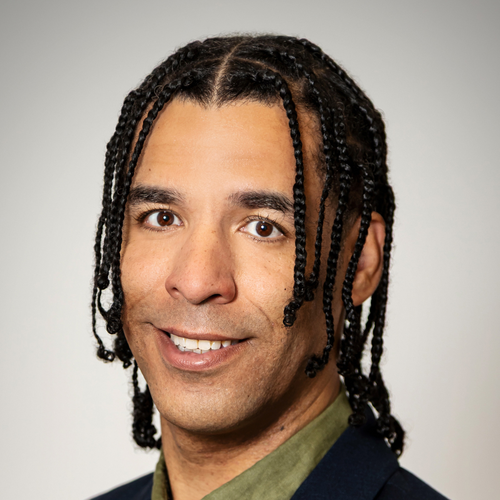
Lucas Berard
2025–26 US student, Fulbright-Austrian Marshall Plan Foundation Award
Dune Johnson
Communictions manager
In February 2026, we had the honor of attending the Fulbright EU-NATO Seminar in Luxembourg and Brussels, an annual event organized by the Fulbright commission in Brussels. This unique seminar brings together Fulbright recipients living in EU-NATO nations, offering a rare opportunity to connect with Fulbrighters beyond one’s host country and to learn more about the European Union and its governing bodies as well as about the North Atlantic Treaty Organization (NATO), the defense alliance that has helped make all member states safer since its founding in 1949.

The journey began upon arrival at the Luxembourg airport, with Fulbrighters finding their way to the hotel. When we all gathered for the first meeting after checking in, the excitement in the air was palpable: whether the program participants were already well versed in the workings of the EU and NATO or only had a basic understanding, everyone knew that this was the start of a trip that would end with each of us having a much deeper, nuanced perspective of the institutions we’d be visiting over the next few days.
The first meeting was kicked off by Erica Lutes, the executive director of the Fulbright commission in Brussels, and Jace Jasper, who works at the commission and organized the 2026 seminar. Following their remarks, Jerome Sheridan, the chairman of the commission’s board, gave us an informative briefing on the European Union to give us all a solid foundation for the days to come. Afterwards we headed to the residence of the US ambassador to Luxembourg. We attended a reception featuring American finger foods and met current program participants and alums from Luxembourg and Brussels as well as Stacey Feinberg, the current US ambassador to Luxembourg. The event provided one of Lucas’s first opportunities to speak with Fulbrighters from across Europe, and it was fascinating to see how programs that appear similar can differ significantly from country to country. For example, one English teaching assistant (ETA) taught at the university level in her host country, while another worked at an agricultural high school.
During her speech, Ambassador Feinberg spoke about the Fulbright Program as a valuable investment in international exchange, a sentiment that echoed throughout each conversation we were part of over the course of the evening. Hearing the experiences of Fulbrighters from across Europe further reinforced the program’s broad impact, and Lucas also took a pause from the thought-provoking conversations for a more playful moment, seizing an opportunity to pretend to deliver a speech from the podium.
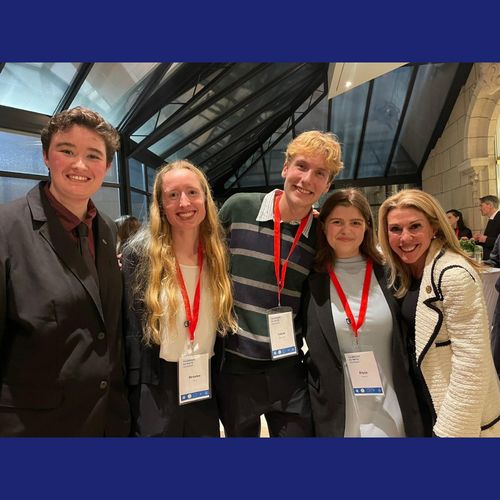 Lucas and other seminar attendees posing with Ambassador Stacey Feinberg (r.)
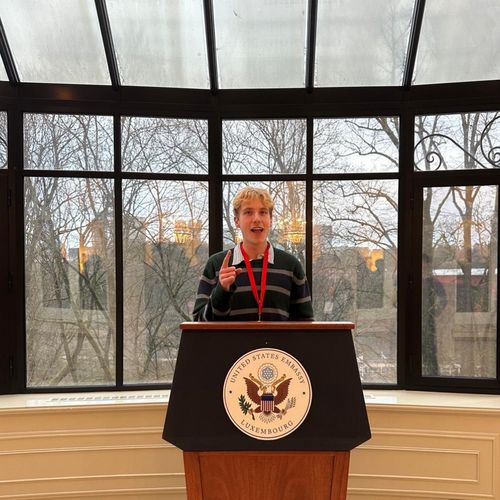 Lucas standing behind the lectern at the residence of the US ambassador to Luxembourg
The next day, we visited the European Court of Justice, where we received a short briefing about a case and then were able to observe the court proceedings. The case was unusual even for seasoned staff because the defendant had chosen to represent himself. One of the most fascinating aspects of the proceedings were the teams of interpreters. They translated the discussion in real time across multiple languages, allowing everyone in the room to follow the exchange on earpieces built into the armrest of each seat in the courtroom. Weeks after the seminar, Lucas still cannot fathom the dedication it must take to master several languages so thoroughly.
On the third day, we visited the European Commission and the European Parliament in Brussels. At the European Commission, three speakers talked to us about how the commission works, the role it plays relative to other EU institutions, and the projects it’s currently working on. As Americans living in the EU, Dune and Lucas both gained useful insights that improved their understanding of the EU’s inner workings, underscoring how the EU-NATO Seminar contributes to the Fulbright mission beyond each participant’s understanding of their respective European host country.
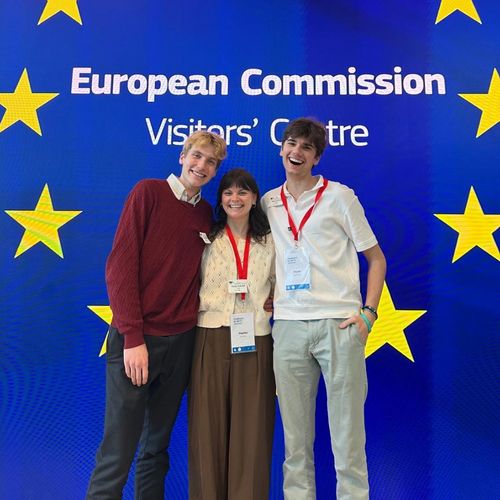 Lucas at the European Commission with other US Fulbrighters in European countries
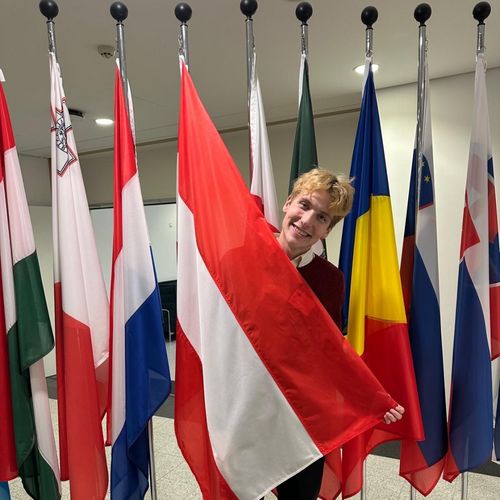 Lucas finds the flag of his host country, Austria.
One interesting thing Lucas learned at the European Parliament was that there were minimum and maximum numbers of seats that could be held by an individual country. Out of the Parliament’s 720 seats, smaller countries such as Luxembourg receive six seats regardless of their population. Germany, by contrast, holds 96 seats, which is disproportionally smaller relative to its population. This arrangement reminded Lucas of the structure of the US Congress, where less populated states receive slightly greater representation.
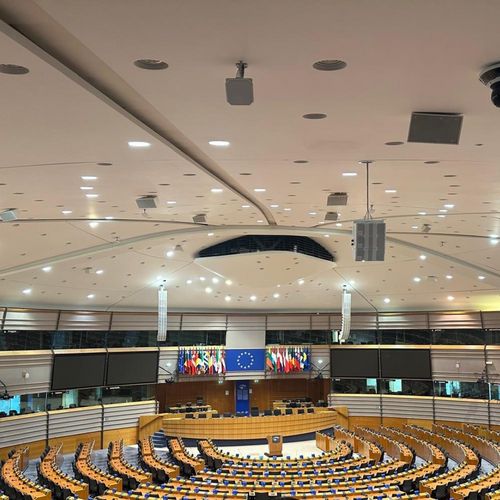 Photo of the European Parliament
The final day of the seminar began with a visit to NATO headquarters. The new headquarters building is designed to resemble two hands coming together, symbolizing the partnership between member nations. On our way there, we also passed the former NATO headquarters a few blocks away. Today, the building serves as the courthouse where suspects connected to the 2016 Brussels bombings are being prosecuted. In the new headquarters, Dune was impressed by the proximity of the missions; whereas diplomatic missions traditionally are not housed together, requiring ambassadors and their staff to travel to and from their counterparts’ missions to engage with one another, the NATO headquarters facilitated more frequent and perhaps deeper exchanges since all 32 NATO member states have missions and ambassadors on site. What’s more, interactions weren’t limited to formal meetings; every member of every delegation had opportunities to meet informally at the café, the restaurant, or at any of the other facilities contained within the building. For Dune, the NATO model represented an ideal setup for diplomatic relations and mutual understanding.
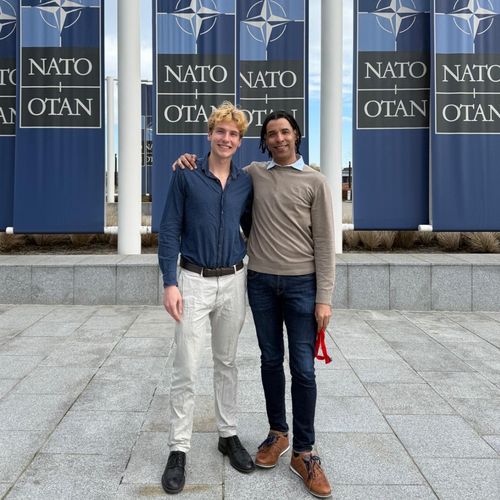 Lucas and Dune pose for a photo outside of NATO headquarters.
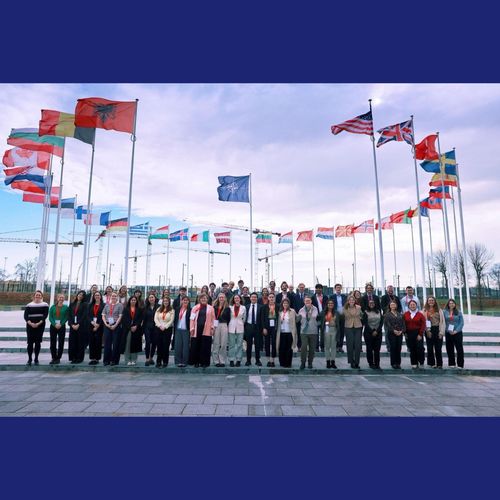 Attendees gather together to pose outside of NATO headquarters.
Later that evening, the entire group gathered one last time for dinner. The meal was an opportunity for us to reminisce not just about the knowledge gained at the institutional visits, but also about the new friendships we had made with US Fulbrighters from all over Europe. We connected with each other through the official seminar program, but we also connected on personal levels, finding people with shared insterests—such as the many conversations Dune had with fellow fans of fantasy and sci-fi—and learning more about them as individuals, as researchers and academics from a wide selection of disciplines, as representatives of various parts of the US and the multifaceted cultural aspects found across the country.
The EU-NATO Seminar was an unforgettable experience. Every single one of us walked away with a deeper awareness of the EU, knowledge that will positively impact our stays in Europe and inform how we talk about the time we spend in our host countries once we’re back in the US. And by better understanding the EU and its institutions, we are also better equipped to talk about the equivalent US institutions with our European colleagues, friends, and peers. In short, we’re all more able to contribute to the Fulbright mission of promoting mutual understanding between the peoples of Europe and the US, more prepared to strengthen the interpersonal bonds between countries that make us collectively safer and our societies more prosperous, and we’re incredibly thankful to the Fulbright commission in Brussels and their partners for making the seminar possible.